Professional Experience
Governed AI Tools for Healthcare
- Healthcare
- MCP
- AI Agents
- Security
- Enterprise Architecture
How the healthcare platform connects
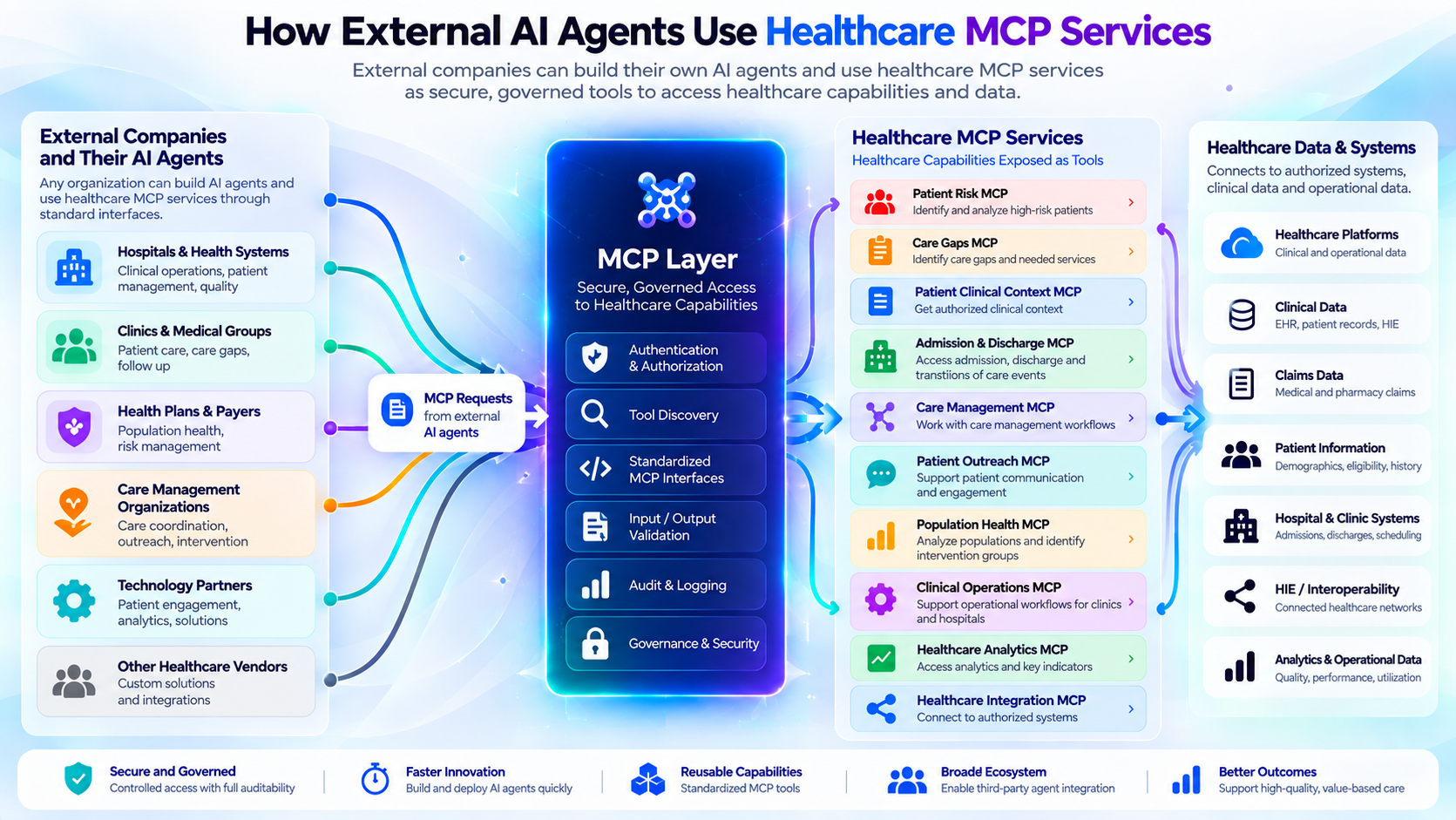
Authorized agents for hospitals, clinics, health plans, and partners request healthcare tools through a governed MCP layer. The layer checks permissions, validates inputs, and records activity before connecting to approved clinical and operational systems.
Select the diagram to view it at full size.
The challenge
Healthcare data and workflows are spread across clinical, care management, and operational systems. AI agents need a defined way to use approved capabilities without direct access to every underlying system.
The architecture
Douglas designed an agentic healthcare platform using Model Context Protocol (MCP). A shared interoperability layer presents authorized healthcare capabilities as discoverable tools for internal and third-party AI agents. Hospitals, clinics, health plans, and technology partners can build their own agents while access remains governed by the platform.
- Patient risk, care gaps, clinical context, admissions, and discharges
- Care management, patient outreach, and population health
- Clinical operations, analytics, and healthcare integrations
How access is governed
The MCP layer defines authentication, authorization, tool discovery, standardized interfaces, input validation, audit logging, and security controls. Agents invoke only the capabilities they are permitted to use. They do not receive unrestricted access to clinical systems or patient information.
A care management example
A high-risk patient workflow can bring together authorized context, risk indicators, care gaps, and clinical events to support intervention planning and care management. Clinical judgment and decisions remain with qualified people.
Reusable foundation
Standardizing healthcare capabilities as MCP tools creates a foundation for partner agents and future workflows involving multiple agents. Each connection follows the same access and governance patterns.
Go deeper
Insight, evidence and a place to start
AI Agents
Connect agents to approved enterprise tools.
ContinueCapabilityEnterprise AI
Build secure foundations for AI.
ContinueInsightAgent governance: who is responsible when AI can act?
The more an AI system can act, the more important identity, authorization, governance and observability become.
Continue